Expedia Group / VRBO

Principal Conversation Designer

A zero-to-one implementation of the Sierra AI assistant for VRBO hosts designed to automate the largest call driver, answer common FAQs, and provide faster, more accurate support than existing self-service options.

Automated responses to missing payment requests, the largest call driver, addressing cases where incomplete account setup was the root cause. This also increased Host authentication rates to over 80% before handoff to a live agent.

Defining the problem

Good conversation design starts with understanding who is actually on the other end of the call. I anchor every project in user goals using a simple template: As a [role], I need to [task] so that I can [goal]. This framing keeps the focus on outcomes rather than features and makes it easier to spot where a flow, help article, or IVR prompt is solving the wrong problem for the wrong person.

The project goal was to bring Sierra AI into the voice, chat, and help funnels for VRBO, with containment as the stated success metric. Containment is easy to measure but it does not tell you whether the interaction actually helped anyone. Reframing around user goals changes what you are designing for. A starting point here was: As a host, I need to get help with my listing so that guests can book my room. That gets closer to the real problem but is still broad enough to mean almost anything. Narrowing it further meant looking at the data.
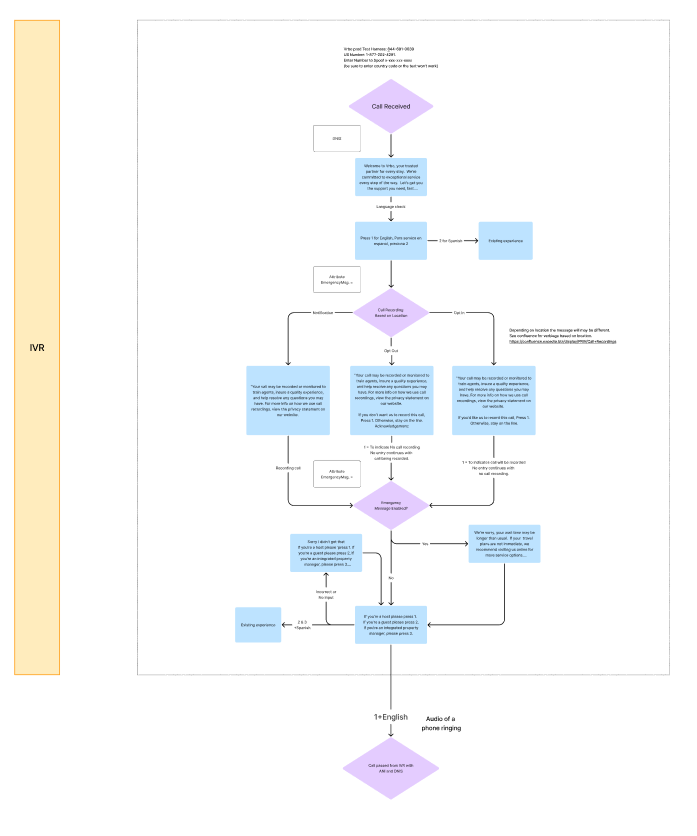
Map of the IVR showing user roles and call paths

A map of the IVR was a first step in understanding our user's role

Refining the use case with data

User goals give direction but data tells you where to focus first. By analyzing call drivers, drop-off points, and agent escalation patterns, we identified which use cases had the highest volume and the lowest self-service success.

High traffic paired with high failure is where conversation design work has the most impact, and where small improvements translate directly into measurable outcomes.

Map of conversation paths for why a host isn't receiving their payments

A map of conversation paths for why a host isn't receiving their payments

When containment isn't resolution

Call driver analysis identified missing payments as the dominant reason hosts contacted support. That focus shaped the initial conversation design work around that journey. But the data surfaced a structural problem: many of the reasons a payment was missing required action outside the platform entirely. A host with incomplete bank details or an outstanding tax filing couldn't resolve the issue through the bot or even through a live agent. The call could be contained but the problem remained open, likely generating a repeat contact.

This pushed the design work toward a more honest framing of what the AI could and couldn't resolve. Rather than treating containment as success, the flows needed to clearly communicate what action the host needed to take, set accurate expectations about timeline, and reduce the likelihood of a repeat call by giving the host a complete picture of what was blocking their payment.

Map of agent responses across common host requests

Mapping what the agent should do across other common host requests

Designing for edge cases

The happy path is the easy part. The real work in conversation design is accounting for what happens when things go sideways: a booking that doesn't match, a policy that changed mid-flow, or a user who gives an answer the system wasn't expecting.

Mapping edge cases early prevents dead ends downstream and surfaces gaps in system capability that need to be resolved before a flow goes live, not after.

Map of agent responses across common host requests

Mapping what the agent should do across other common host requests

Visualizing the conversation

While we started with voice, the same system would need to support chat. To give the team a feel for how this would work, I pulled transcripts from several calls and built a chat prototype in Figma. Laying out the full conversation as a single component first made it easy to create individual frames showing how the exchange evolved, and kept edits in one place as we continued to refine the story.

Figma prototype showing the chat conversation flow
Agent interface redesigned for single-screen laptop use during COVID

Agent interface redesigned overnight when call centers went remote during COVID, keeping live handoffs functional on single-screen laptops

Expedia Traveler and Agent Chat

Designing chat for both sides of the conversation, from traveler self-service to the agent tools that back it up.

Learn more about my Expedia work →

Generative and Agentic AI

From prompt design to agentic workflows, work at the frontier of what AI can do in a product context.

Read the case study →

Next: Generative and Agentic AI

Check out my About or Resume

Marty Hall International Logo