COMPANY
Oracle
ROLE
Principal Designer / Working Group Lead
THE PROBLEM
Oracle's Redwood Design System had no patterns for generative or agentic AI at a moment when the entire industry was moving in that direction.
THE OUTCOME
The working group produced new AI design pattern proposals, defined the initial use cases and user goals used to explore AI integration in Oracle Fusion Applications, and presented to Design VP leadership three times covering AI branding for Oracle and the use of generative AI for Redwood illustrations. Twelve designers active across the organization.
Pioneering AI-Driven Design at Oracle
In my role as a Principal Designer at Oracle, I took on several major projects in addition to my day-to-day work. A focus emerged on facilitating the evolution of the Redwood Design System for Generative AI and Agentic AI UX.
My efforts began with research into emerging AI tools. I quickly established a working group to share successes and build collective understanding. We started with prompt refinement in DALL-E and Midjourney, then advanced our exploration to Stable Diffusion embeddings, spurring trials for creating images in the Redwood Illustration style.
Images created with Midjourney
Explorations in Generative UX
Generative AI UX Patterns
For generative text, I began experimenting with Jasper and Rytr. I launched a working group to explore this space, and within the first few months, ChatGPT came onto the scene and sparked an intense focus on text generation.
We gathered to brainstorm use cases for this transformative new technology: Could AI help write goals, feedback, and performance reviews? Might it suggest new ways to analyze company data or health records? The potential applications for our Clarity of Purpose framework seemed endless.
RESULTS
Defining Oracle's AI design direction
Over the course of the working group, the team produced three presentations to Design VP leadership covering two strategic areas: how Oracle should brand its AI experiences, and how generative tools could be used to create illustrations in the Redwood style. Both topics directly influenced how the design organization approached the AI transition.
The group also wrote the initial use cases and user goals that seeded Oracle's exploration of AI integration into Fusion Applications, one of Oracle's core enterprise product lines. With twelve active members drawn from across the design organization, the working group functioned as an internal research and strategy function at a moment when the industry had no established playbook to follow.
Agents and Automation
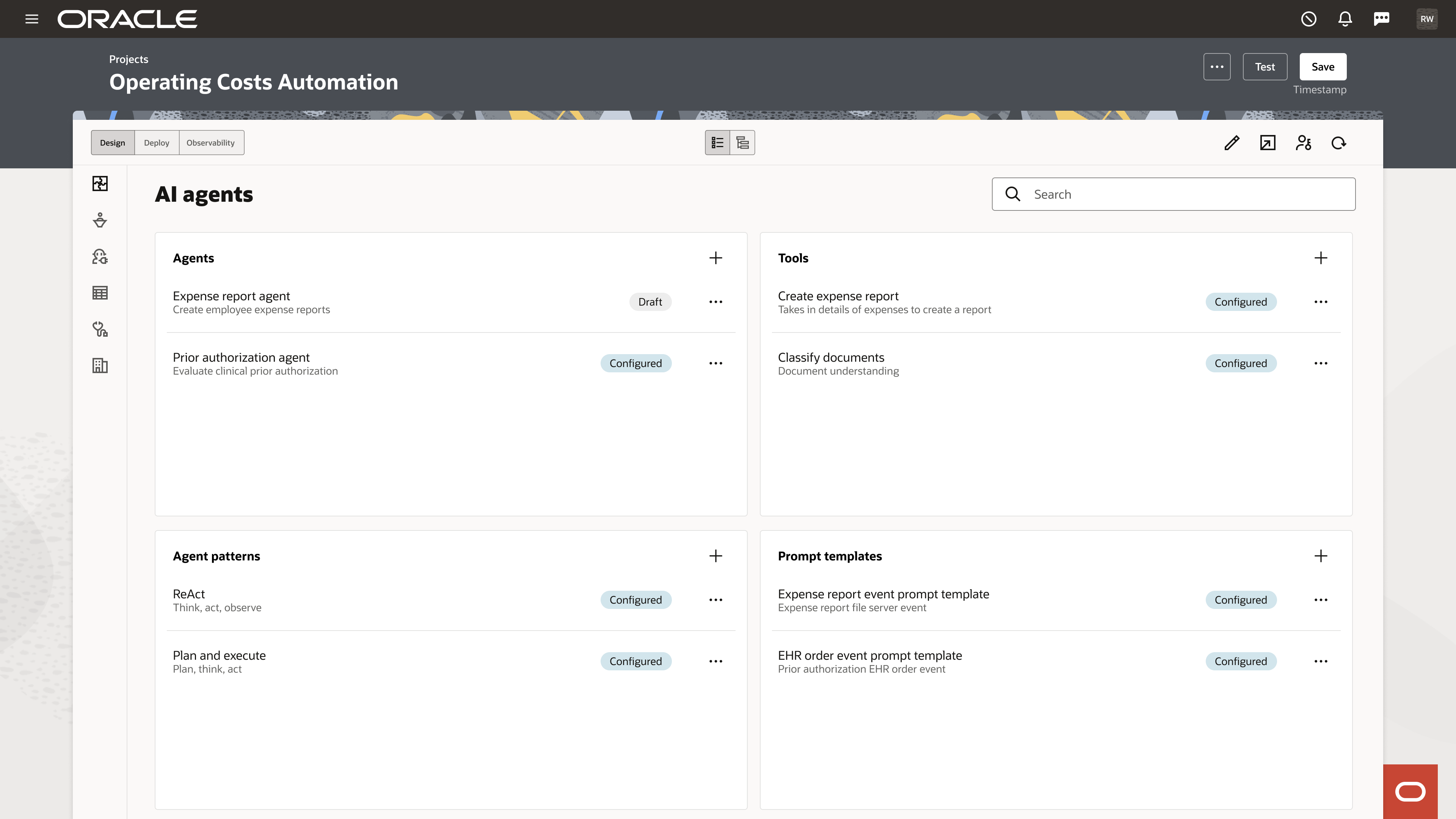
The group eventually shifted its focus to designing common controls to support these use cases. Monthly reports to our Design VPs led to a week-long design thinking exercise. As the synergy between search and generative AI became clear, I turned my attention toward AI Agents. Our Integration tools held the key to agent automation.

AI Agents added to Integraiton projects
RELATED PROJECTS
Generative and Agentic AI
The systems thinking that underpins agentic UX work: components, tokens, and structure that scale across a product organization.
Read the Agentic AI case study →
Conversation Design
Designing voice and chat flows that start with user goals, not containment metrics.